
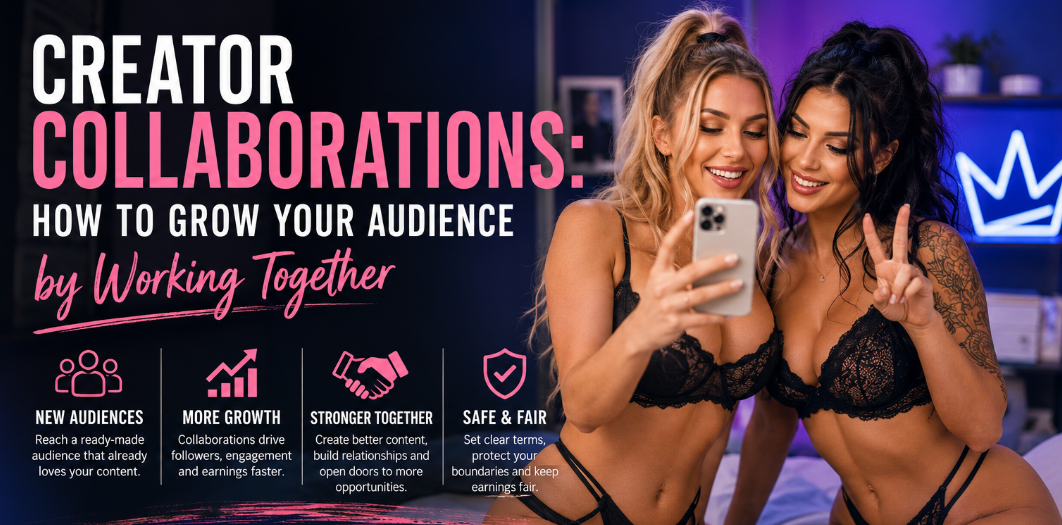
Creator Collaborations: How to Grow Your Audience by Working Together
There is a limit to how far you can grow on your own. The fastest way past it is to borrow someone else's audience, and that is exactly what a collaboration does. When two creators work together, each one gets introduced to a room full of people who already enjoy the kind of content they make. Done well, creator collaborations grow your reach faster than almost anything you can do solo.
This guide covers why collaborations work, the different forms they take, how to find and pitch the right partner, and how to keep yourself safe and your earnings fair along the way.
Why do collaborations grow audiences faster than solo content?
Posting on your own grows your audience one new follower at a time. A collaboration puts you in front of an entire established audience at once, and crucially, an audience that has already shown it likes content like yours. That warm introduction converts far better than cold discovery.
Collaborations also create content you could not make alone, which gives your existing audience something new and gives both partners a reason to promote it hard. The result is reach, fresh material and social proof, all from a single project.
There is a compounding effect, too. Each collaboration introduces you to a new audience, and some of those new followers will themselves be creators or have their own networks, opening the door to further partnerships. Growth through collaboration tends to build on itself in a way that solo posting rarely does.
Types of collaboration
Collaborations come in several forms, and you can mix them:
Cross-promotion: you each promote the other to your own audience, sending followers in both directions.
Shoutout for shoutout: a simple swap where you each post about the other, often the easiest place to start.
Joint content: you create something together, which both of you can post and sell.
Takeovers and features: one creator appears on the other's feed or content for a set period.
Lighter forms like shoutouts are low risk and quick to arrange. Joint content takes more planning but tends to deliver the biggest return.
Finding the right partner
The best collaborations are between creators whose audiences overlap without being identical. You want someone in a similar or complementary niche, so their followers are likely to enjoy your content, but with enough difference that you each bring something new.
Audience size matters too. Partnering with someone of a roughly similar size keeps things balanced, since both of you bring comparable value to the table. Look as well at how someone presents themselves and whether your styles and boundaries align, because a mismatch there causes friction later.
How to pitch a collaboration
Keep your pitch short, friendly, and specific. Open by showing you actually know their content, explain the kind of collaboration you have in mind, and make clear what is in it for them. Creators are pitched constantly, so a vague message asking to collab gets ignored, while a clear idea with an obvious benefit gets a reply.
Suggest a concrete first step rather than leaving it open. Proposing a simple shoutout swap or a single piece of joint content is far easier to say yes to than an open-ended partnership.
It also helps to make the first move easy to accept. Offer to do your part first, such as posting your shoutout before asking for theirs, or sending over a content idea fully formed. Lowering the effort and the risk for the other person makes a yes far more likely.
Setting terms and expectations
Before you create anything, agree on the details. Decide what you are making, who posts what and when, how each of you will promote it, and what each person is responsible for. Putting this in writing, even just a message thread you both confirm, prevents the misunderstandings that sour otherwise good partnerships.
Clear expectations protect the relationship. When both people know exactly what they have signed up for, the project runs smoothly, and you are far more likely to want to work together again.
Planning and producing collab content
Treat a joint shoot like any other batch: plan it, theme it, and capture plenty so you both come away with enough material. Agree on the concept in advance so neither of you arrives unsure of the plan, and shoot enough variety that you each have distinct pieces to post rather than identical content.
Coordinate your posting so the collaboration lands with impact. Releasing your pieces around the same time and promoting each other as you do concentrates the attention and gives both audiences a reason to take notice.
Splitting revenue and promotion fairly
If a collaboration earns money, agree how it is split before you start, not after. For joint content that you both sell, a clear arrangement, whether that is an even split or each keeping what they sell on their own page, avoids any awkwardness later.
Promotion should feel balanced too. If one person is putting in noticeably more reach or effort, acknowledge that in how you share the rewards. Fairness is what turns a one-off collaboration into an ongoing partnership.
Staying safe and protecting your boundaries
Working with someone new means sharing space, and sometimes content, with a person you may not know well. Take it slowly. Start with low-commitment collaborations like shoutouts before moving to anything more involved, and get a sense of how someone communicates and respects limits first.
Set your boundaries clearly up front and only agree to what you are comfortable with. A good collaborator will respect your limits without question. If someone pushes against them, treat that as your answer and walk away. Protecting yourself always comes before any growth opportunity.
What are the red flags to look out for?
Not every potential partner is a good one, and a few warning signs are worth respecting. Be cautious of anyone who pushes past your stated boundaries, is vague about terms, or wants to rush straight into involved content before you have built any trust.
Reluctance to agree on clear terms or put anything in writing.
Pressure to go further or faster than you are comfortable with.
A pattern of falling out with previous collaborators, if you can find it.
Promises of reach or numbers that sound too good to be true.
Trust your instincts. A collaboration is meant to help you grow, and no opportunity is worth ignoring your own comfort or safety for. Walking away from the wrong partner costs you nothing, while the wrong partnership can cost you a great deal.
Measuring whether a collaboration worked
After a collaboration, look at what it actually delivered. Track the new followers, the engagement, and any earnings that came from it, and compare that against the effort it took. Some partnerships will clearly be worth repeating; others will tell you to look elsewhere.
Pay attention to which partners and which formats brought the most relevant audience, not just the biggest numbers. A smaller collaboration that brings genuinely interested followers is worth more than a large one that brings people who never engage again.
Frequently asked questions
How do I find creators to collaborate with?
Look for creators in a similar or complementary niche whose audience would enjoy your content, ideally of a roughly similar size to yours. Engage with their content genuinely before reaching out, so your pitch arrives as a familiar name rather than a stranger.
Should collaborators have a similar audience size?
A roughly similar size keeps the exchange balanced, since both of you bring comparable value. Big differences are not impossible, but the smaller creator usually needs to offer something extra to make it worthwhile for the larger one.
How do we split earnings from joint content?
Agree on it before you start. Common approaches are an even split of anything the joint content earns, or each creator keeping what they sell on their own page. Whatever you choose, confirm it in writing so there is no confusion once money is involved.
How do I stay safe collaborating with someone new?
Start small with a low-commitment collaboration like a shoutout, set your boundaries clearly, and only agree to what you are comfortable with. Give yourself time to see how the other person communicates and respects limits before taking on anything more involved.
Grow together
The right collaboration can put your content in front of thousands of new people. Find your partners, plan it properly, and grow your audience together on MoreThanFanz.